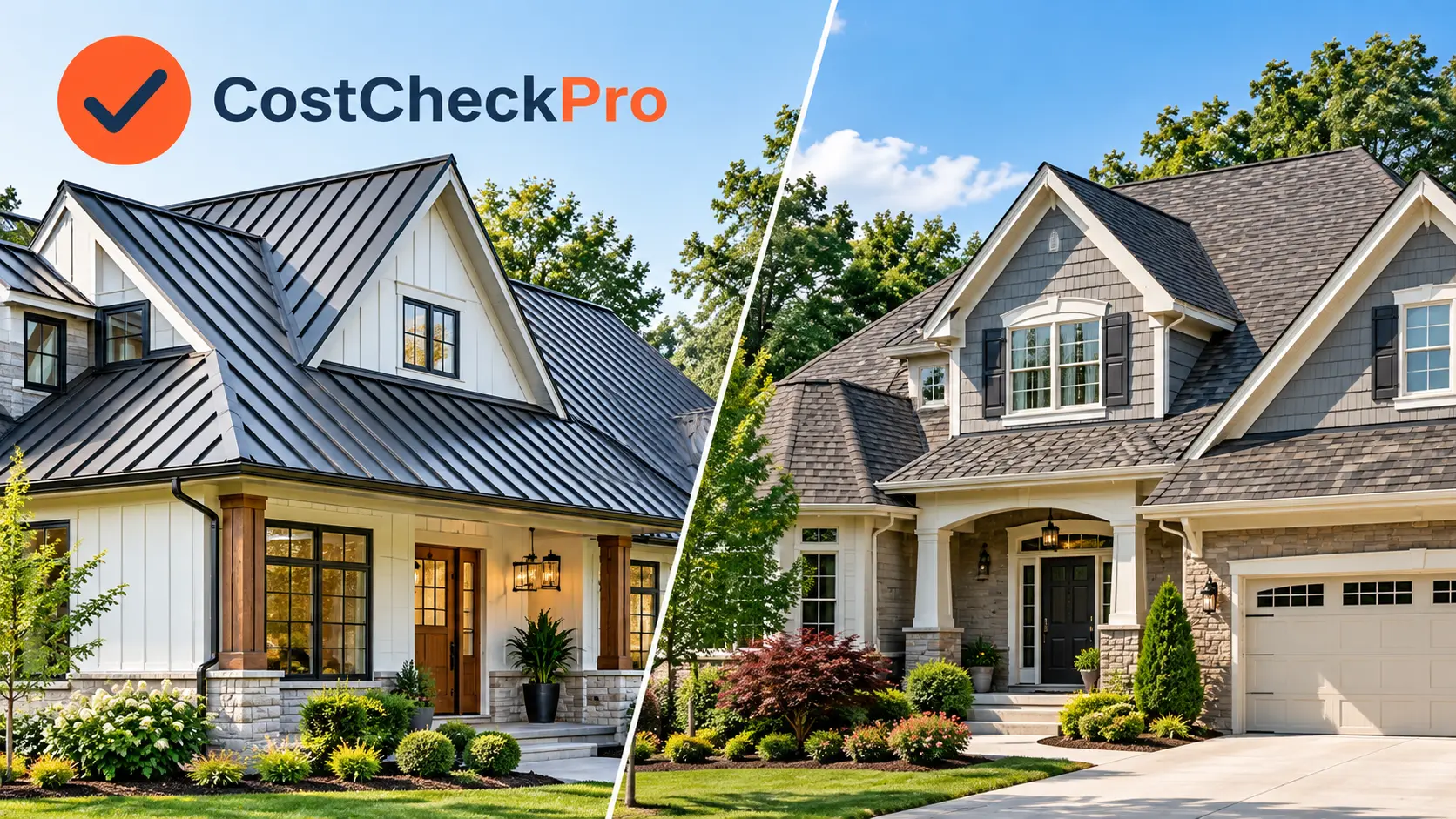
Asphalt shingles cost less upfront ($4.50–$7.00/sq ft) but last 25–30 years. Metal roofing costs more ($8.00–$14.00/sq ft) but can last 40–70 years — often making it the better value if you plan to stay in the home long-term.
The metal-vs-shingle debate usually comes down to one question homeowners don't ask themselves clearly enough: how long do you plan to own this house? Get that answer first, and the rest of the decision gets a lot easier.
Upfront cost: shingles win clearly
For a typical 1,800 sq. ft. roof, architectural shingles run roughly $9,500–$14,500 installed. The same roof in standing seam metal runs $16,500–$29,000. That gap is real and it's the reason shingles remain the default choice for most U.S. homes.
Lifespan: metal wins by a wide margin
| Material | Typical lifespan | Cost per year of service* |
|---|---|---|
| Architectural shingle | 25–30 years | ≈ $13 – $19 /sq ft-life |
| Standing seam metal | 40–70 years | ≈ $7 – $14 /sq ft-life |
*Rough cost-per-year calculated as installed cost ÷ expected lifespan — a simple way to compare value, not an exact figure.
Where metal pulls ahead beyond lifespan
- Energy efficiency: reflective metal roofing can lower cooling costs in hot climates.
- Storm resistance: metal handles hail and wind better than shingles in most ratings.
- Resale perception: buyers in some markets view a newer metal roof as a strong selling point.
Where shingles still make more sense
- You plan to sell within 5–10 years and want to recover cost quickly.
- Your HOA or local architectural guidelines restrict metal roofing.
- Upfront budget is the deciding constraint.
Types of metal roofing and how they're priced differently
| Metal type | Cost per sq. ft. installed | Notes |
|---|---|---|
| Corrugated/exposed-fastener panels | $6 – $9 | Cheapest metal option, visible screws need periodic resealing |
| Standing seam (concealed fastener) | $8 – $14 | Most popular residential choice, cleaner look, fewer leak points |
| Metal shingles/tiles | $9 – $16 | Mimics traditional shingle or tile appearance at metal's durability |
| Stone-coated steel | $10 – $18 | Premium option, closely resembles tile or shake at a fraction of the weight |
Standing seam remains the default recommendation for most homeowners switching to metal, balancing cost, appearance and the lowest long-term leak risk among the metal options due to its hidden fastener design.
Noise, heat and other metal roofing myths worth addressing
- "Metal roofs are loud in the rain." With proper solid decking and standard attic insulation, sound levels are comparable to shingle roofs — the loud-tin-roof reputation mostly comes from older barn-style installations without a solid substrate underneath.
- "Metal roofs attract lightning." Metal doesn't attract lightning any more than any other roofing material; if anything, metal's non-combustible nature makes a strike less dangerous than on a shingle roof.
- "Metal roofs make the house hotter." The opposite is generally true — reflective metal coatings reduce attic heat gain compared to dark asphalt shingles, which is part of the energy savings mentioned earlier.
- "Metal roofs dent easily." Quality standing seam panels resist dents from normal hail; very large hail can dent any roofing material, metal included, though metal is rated highest for impact resistance among common options.
Installation differences that affect timeline and cost
Metal roofing installation generally takes longer per square foot than asphalt shingles, since panels require precise measuring, cutting and seaming rather than simply overlapping shingle courses. A typical shingle roof might take 1-2 days; the same size metal roof often takes 3-5 days, particularly for standing seam with its specialized seaming equipment. This longer timeline is already factored into metal's higher labor cost, but it's worth planning around if timing matters — a metal roof replacement is simply a bigger project disruption than a shingle swap.
Finding a qualified metal roofing installer
Not every roofing contractor who installs shingles well is equally experienced with metal — the seaming technique, especially for standing seam, has a real learning curve, and a poorly seamed metal roof is more prone to leaks than a well-installed shingle roof. When comparing quotes for a metal roof specifically, it's worth asking how many metal roofs (not just roofs generally) the crew has installed, and ideally seeing photos or references from metal-specific past jobs rather than assuming general roofing experience fully transfers.
Insurance and metal roofing discounts
Many homeowners insurers offer a premium discount for metal roofing, particularly in hail-prone or wildfire-risk regions, recognizing its superior impact and fire resistance compared to asphalt shingles. The discount amount varies by insurer and region, but it's worth specifically asking your insurance company about a metal roof discount when budgeting the project, since this effectively lowers the real cost gap between metal and shingles over the life of the roof beyond just the energy savings already discussed.
A side-by-side 20-year cost projection
For a 2,000 sq. ft. roof: architectural shingles installed today at roughly $13,000 will likely need full replacement again around year 27 — just past the 20-year mark for this comparison, so one installation covers the full period, but with a shingle lifespan running shorter, maintenance costs (occasional repairs, granule loss issues) tend to climb in years 15-25. Standing seam metal installed today at roughly $22,000 requires no replacement within 20 years and typically needs minimal maintenance beyond periodic inspection. On raw installation cost alone shingles still come out ahead over a single 20-year window, but factoring in insurance discounts, energy savings, and reduced mid-life repair costs narrows that gap considerably — often enough that a homeowner planning to stay 20+ years finds the numbers closer than the sticker price difference suggests.
Weight considerations and structural requirements
Standing seam metal panels are actually lighter per square foot than asphalt shingles in most cases, which is a genuine advantage for older homes where roof structure load capacity is a concern. This is counterintuitive to many homeowners who assume metal is the heavier option. Stone-coated steel, the premium tile-look option, runs closer to shingle weight. For most standard residential framing, neither material requires structural reinforcement, but it's a relevant question for older homes or homes considering a tile-look metal roof specifically, where a structural engineer's quick assessment is sometimes worth the modest added cost for peace of mind.
Color and coating options for each material
Asphalt shingles come in a wide range of blended color options achieved through granule mixing, generally offering more subtle, natural-looking variation than solid-color metal panels. Metal roofing colors come from a baked-on or powder-coated finish, offering bold, consistent color but historically fewer "blended" natural tones, though manufacturers have expanded options significantly in recent years including textured and multi-tone metal finishes that more closely mimic shingle variation. For homeowners prioritizing a very specific architectural look, it's worth viewing physical samples of both materials in person rather than relying on photos, since color rendering can look different under actual roof-angle sunlight than in a brochure or online image.
Repairing vs. replacing sections: a key practical difference
Asphalt shingles are straightforward to spot-repair — a roofer can replace a handful of damaged shingles without disturbing the surrounding roof, and the repair is often difficult to spot once complete, assuming reasonably close-matching replacement shingles. Standing seam metal is more complicated to spot-repair, since panels run in long continuous sections; a damaged section sometimes requires replacing an entire panel run rather than a small patch, and achieving an invisible repair is harder due to subtle color weathering differences between old and new metal. This is a real practical trade-off worth weighing if minor storm damage (a fallen branch, for example) is a realistic concern in your area.
Environmental considerations beyond energy efficiency
Metal roofing is highly recyclable at end of life, and many metal roofing products already contain a significant percentage of recycled content — genuinely favorable from a lifecycle environmental standpoint compared to asphalt shingles, which are petroleum-based and, while increasingly recyclable through specialized programs, are still predominantly landfilled at the end of their service life in most regions. For homeowners weighing environmental impact alongside cost, this is a meaningful factor in metal's favor beyond the energy-efficiency benefits already covered.
Making the decision: a simple framework
Boiled down to the core trade-off: choose shingles if upfront cost is the primary constraint, you're not planning to stay in the home for the roof's full lifespan, or local HOA rules limit your options. Choose metal if you're planning to stay long-term, want to minimize future roofing hassle and cost, live in a severe-weather or high-heat region where the durability and energy benefits compound, or simply prefer the aesthetic and are comfortable with the higher upfront investment. Neither choice is wrong — they're optimized for different ownership timelines and priorities, which is really what this entire comparison comes down to.
Financing considerations unique to metal roofing
Because metal roofing carries a higher upfront cost, financing plays a bigger practical role in the decision than it does for shingles. The same financing options covered for roofing generally — contractor plans, HELOCs, insurance claims for storm-related replacement — apply equally to metal, but the larger loan or credit amount involved makes comparing interest rates and terms across a few lenders more worthwhile than it might be for a smaller shingle project. Some homeowners specifically choose a longer-term HELOC for a metal roof given its multi-decade lifespan, reasoning that financing a 50-year asset over 10-15 years is a more proportionate match than paying it off in 2-3 years the way a shorter-lived improvement might be financed.
Regional popularity patterns worth knowing
Metal roofing has historically been more common in certain regions — rural and mountain areas where snow-shedding performance matters, and the South and coastal regions where wind and hail resistance are valued — while asphalt shingles remain the default in much of suburban America partly due to cost and partly due to long-established contractor familiarity and supply chains. This regional pattern is shifting as metal becomes more mainstream and affordable, but it's still worth knowing when gathering quotes: in regions where metal is less common, you may need to search a bit further to find a contractor with deep standing-seam experience, which circles back to the installer-vetting point covered earlier.