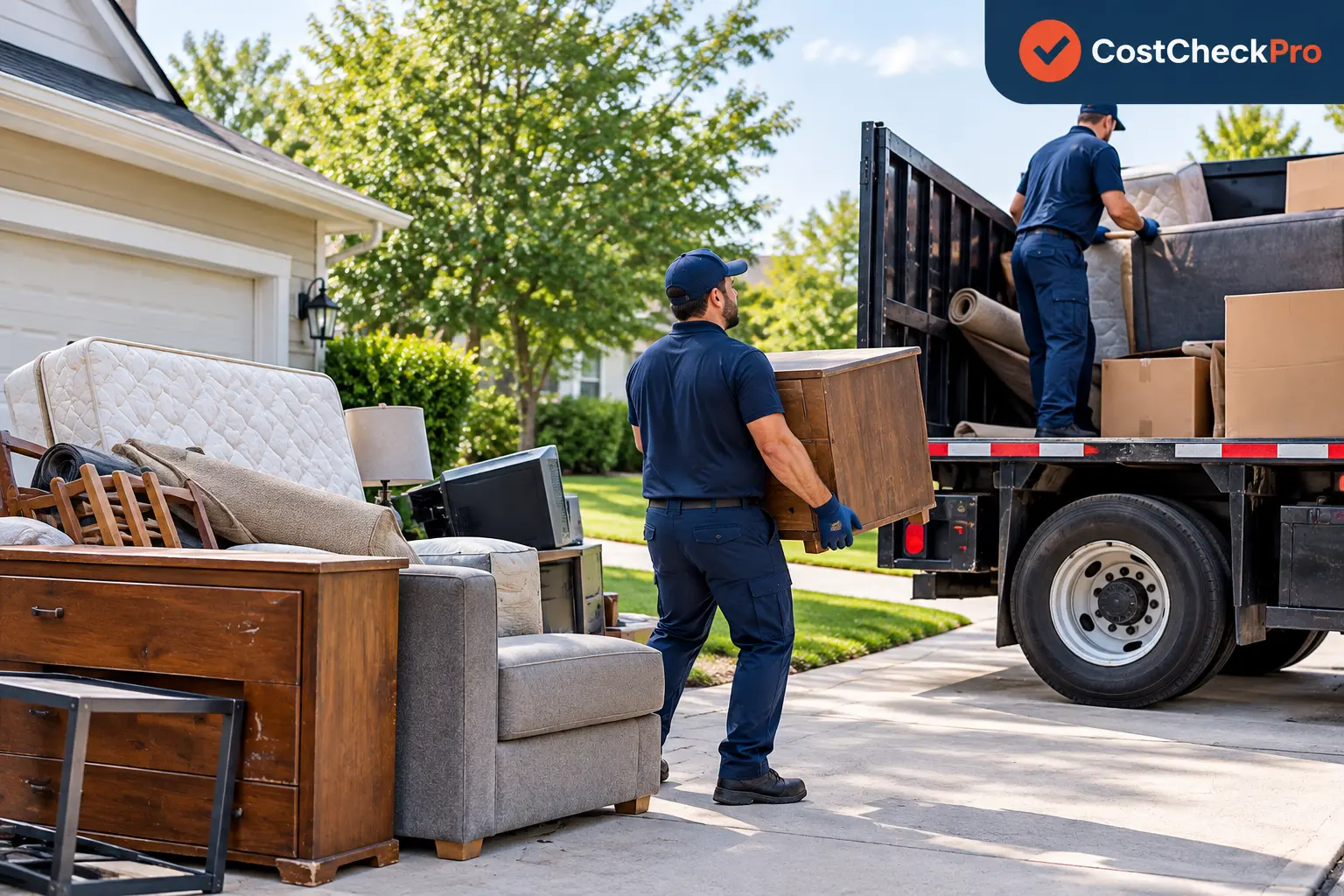
A single item runs $75–$150, a quarter truckload $150–$260, and a full truckload $560–$750. Heavy debris like concrete or dirt adds a separate surcharge. Try the junk removal calculator for your specific load.
Ask three junk removal companies for a quote on "a garage full of stuff" and you'll get three different numbers — not because anyone's overcharging, but because "a garage full of stuff" isn't a pricing unit. Almost every company in this industry prices by truck volume, and once you know how that works, comparing quotes gets a lot easier.
The pricing unit is the truck, not the pound
Junk removal trucks are typically divided visually into quarters. When a crew arrives, they estimate how much of the truck bed your items will fill and price accordingly. This is why a load of lightweight but bulky items — old furniture, boxes, a mattress — can cost close to the same as a load of denser material that takes up the same space.
| Load size | Typical price | What it usually looks like |
|---|---|---|
| Single item | $75 – $150 | Couch, mattress, one large appliance |
| 1/4 truckload | $150 – $260 | Small room cleanout |
| 1/2 truckload | $260 – $420 | Garage or 1–2 full rooms |
| 3/4 truckload | $420 – $560 | Multi-room cleanout |
| Full truckload | $560 – $750 | Whole-home or estate cleanout |
Three things that push a quote above the "standard" range
- Heavy materials. Concrete, dirt, brick and roofing debris are dense enough that most companies price them separately by weight rather than truck space, since a small pile can weigh far more than it looks.
- Difficult access. Long carries from a backyard, narrow stairwells, or no parking near the door add labor time that isn't reflected in the base truckload price.
- Special disposal items. Mattresses, tires, paint and electronics often carry separate landfill or recycling fees on top of the standard load price, since they can't just go into a regular dumpster.
How to get an accurate quote over the phone
Since pricing is about volume, the most useful thing you can do before calling is estimate size honestly: "about half a one-car garage" gets you a far more accurate phone quote than "not that much stuff." Photos, if the company accepts them, close that gap even further and reduce the chance of a surprise adjustment on pickup day.
How junk removal pricing differs by region
Two of the biggest hidden costs in junk removal — labor rates and landfill tipping fees — vary a lot by region, which is why the same half-truckload can cost noticeably different amounts depending on where you live.
| Region | Typical price adjustment | Why |
|---|---|---|
| Northeast | +15% to +25% | High landfill tipping fees and labor costs |
| West Coast | +20% to +30% | Among the highest disposal fees in the country, plus stricter recycling mandates |
| Midwest | Baseline to -10% | Lower tipping fees, competitive local labor market |
| South | Baseline to -15% | Generally the lowest landfill and labor costs nationally |
What actually happens on pickup day
- Arrival and walkthrough. The crew looks at everything you want removed and confirms the load size and price before touching anything.
- Final price confirmation. If the load matches what was described on the phone, the quote holds; if it's noticeably larger, they'll explain the adjustment before starting.
- Loading. Items are carried to the truck — this is where access (stairs, long driveways, tight hallways) affects how long the job takes.
- Sweep and cleanup. A thorough crew sweeps the area where items were sitting before leaving.
- Sorting at the facility. Reputable companies separate donatable items, recyclables and true landfill waste after leaving your property, not on-site.
How to get an accurate phone quote
Since pricing is based on volume, the more specific you can be upfront, the less likely the final price is to change on arrival. Useful details to share when you call:
- Room-by-room description: "a one-car garage, mostly boxes and an old bike" gives a much tighter estimate than "a bunch of stuff."
- Heavy materials called out separately: concrete, dirt, tile or roofing debris should be mentioned specifically, since these are priced differently than general junk.
- Access notes: stairs, long carries, or no truck parking near the door all affect labor time.
- Photos if the company accepts them: many do over text, and it's the single best way to lock in an accurate quote before anyone arrives.
Where your junk actually goes
Most reputable junk removal companies don't send everything straight to a landfill. A typical load gets sorted into three streams: items in good condition are donated to local charities or resale shops, recyclable materials (metal, electronics, cardboard) are routed to recycling facilities, and only what's left — genuinely unusable material — goes to the landfill. Some companies advertise their landfill diversion rate; if that matters to you, it's worth asking about directly, since diversion practices vary widely between companies.
Junk removal vs. the alternatives
Junk removal isn't the only way to clear unwanted items, and it isn't always the cheapest — it's usually the most convenient. Here's how it stacks up against the common alternatives.
| Option | Typical cost | Best for |
|---|---|---|
| Full-service junk removal | $75 – $750+ by load size | Convenience, heavy or bulky items, time-sensitive cleanouts |
| Dumpster rental | $300 – $600 for a week | Ongoing projects (renovations) generating debris over several days |
| Self-haul to the dump | $20 – $80 in dump fees + truck rental/gas | Smaller loads and homeowners with their own truck |
| Curbside bulk pickup (municipal) | Free to low-cost, often included in city services | Standard furniture and appliances, with scheduling limits |
The deciding factor is usually time versus money: self-hauling and municipal pickup cost less but require your own labor and a flexible schedule, while full-service junk removal costs more but removes the physical work and lets you set the timeline.
Pricing considerations for common individual items
Beyond load-size pricing, a few specific items come up often enough to deserve their own notes:
- Mattresses: Often carry a separate recycling fee ($10-$30) on top of load pricing, since they can't be compacted like other debris.
- Hot tubs: Require disassembly before removal and typically cost $150-$400 on their own due to the weight and labor involved.
- Pianos: Upright pianos run $150-$350 to remove; grand pianos can run higher due to the specialized equipment needed to move them safely.
- Exercise equipment: Large machines (treadmills, home gyms) are often priced like a single large item, in the $75-$150 range depending on size and whether disassembly is needed.
- Construction debris: Drywall, tile and lumber from a renovation are typically priced by weight rather than volume, since they're much denser than household junk.
How to prepare for pickup day
A little prep work can shave real money off the final price, since it reduces the labor time the crew spends on your job:
- Consolidate everything in one area — a garage, driveway or single room — so the crew isn't walking through the whole house.
- Clear a path to the truck. Move obstacles out of hallways and doorways ahead of time.
- Separate anything you're keeping. Crews work from what's pointed out as "take this," so ambiguity slows things down and risks mistakes.
- Have payment ready. Most companies collect payment on completion, and having a card or payment method ready keeps the appointment moving.
Questions worth asking before you book
- "Is the quote firm, or does it depend on what you see on arrival?" Phone quotes based on a description are naturally estimates; ask how much the price typically moves once a crew sees the job in person.
- "Are you licensed and insured?" This protects you if something gets damaged during the removal.
- "What's your cancellation or rescheduling policy?" Useful to know upfront, especially for time-sensitive cleanouts like move-outs.
- "Do you charge extra for stairs or long carries?" Better to know this before the truck shows up than to be surprised by it.
Junk removal vs. renting a dumpster
For a one-time cleanout, these two options solve the same problem very differently, and the cheaper option isn't always the one with the lower sticker price.
| Junk removal | Dumpster rental | |
|---|---|---|
| Typical cost | $150 – $750 depending on load | $300 – $600 for a 10-20 yard dumpster, 7-day rental |
| Labor | Included — crew does the lifting | Not included — you load it yourself |
| Timeline | Same-day or next-day, job done in hours | Sits on your property for days while you fill it |
| Best for | Finished cleanouts, heavy items, limited time or mobility | Ongoing projects (renovation debris generated over days) |
As a rule of thumb: if everything is already out and ready to go, junk removal is usually faster and not meaningfully more expensive. If you're mid-renovation and debris will keep accumulating over several days, a dumpster often works out cheaper since you're not paying labor for a job you can do yourself over time.
Items that cost extra — or aren't accepted at all
Standard junk removal pricing assumes general household items. A few categories fall outside that and either carry a surcharge or require a different service entirely:
- Hazardous materials: paint, chemicals, pesticides, car batteries and propane tanks are not accepted by most junk removal companies and need a hazardous waste facility instead.
- Tires: usually accepted but with a per-tire disposal fee, since most landfills charge extra to process them.
- Electronics: TVs, monitors and computers often carry an e-waste recycling fee due to the materials inside them.
- Mattresses: frequently subject to a separate disposal fee even within a standard load, for the same reason discussed earlier — they're bulky relative to their weight and some states require special mattress recycling.
How to prepare before the crew arrives
A little prep work can shave meaningful time — and sometimes cost — off a junk removal job:
- Consolidate items in one area. A pile in the driveway or garage is faster to load than items scattered through multiple rooms.
- Clear a path. Make sure hallways, stairs and doorways are unobstructed so the crew isn't navigating around other belongings.
- Separate anything you're keeping. Clearly set aside items that shouldn't be touched, to avoid confusion during a fast-moving job.
- Confirm parking. Let the company know if their truck will need a permit or special arrangement to park close to the pickup area.
Same-day vs. scheduled pickup pricing
Most companies price same-day service the same as a scheduled appointment, as long as a slot is available — junk removal isn't typically an "emergency surcharge" category the way plumbing or locksmith services are. Where cost can differ is in last-minute weekend or holiday requests, when a company may charge a modest premium simply due to limited crew availability rather than urgency itself.
How companies actually calculate "truck percentage"
The quarter/half/full-truck system can feel abstract until you see how it's actually measured. A standard junk removal truck bed is typically divided into visual sections — most crews are trained to eyeball a load against these sections rather than calculate exact cubic footage. A load that fills the back two feet of the truck is roughly a quarter; one that reaches the halfway point of the bed is roughly half, and so on. This is also why two companies can disagree slightly on the same pile — one crew member's "just over a quarter" is another's "just under a half" — and why getting an in-person or photo-based quote tends to be more reliable than a phone description alone for larger or oddly-shaped loads.
Typical cost by cleanout type
| Cleanout type | Typical load size | Typical cost |
|---|---|---|
| Single room decluttering | 1/4 truckload | $150 – $260 |
| Garage cleanout | 1/2 truckload | $260 – $420 |
| Basement cleanout | 1/2 – 3/4 truckload | $260 – $560 |
| Full apartment (1-2 bedroom) | 3/4 – full truckload | $420 – $750 |
| Estate or whole-home cleanout | Multiple truckloads | $750 – $2,500+ |
Estate cleanouts in particular are priced case by case, since the mix of furniture, boxes, and sometimes hazardous or sensitive materials (old chemicals, documents) varies far more than a standard single-room job.
Free and low-cost alternatives worth considering first
Paid junk removal isn't always the only option, especially for smaller loads:
- Municipal bulk pickup. Many cities offer scheduled bulk trash pickup a few times a year at no extra cost — worth checking your city's sanitation calendar before booking a paid service for a load that would qualify.
- Charity donation pickup. Organizations like Habitat for Humanity ReStore or local charities often pick up usable furniture and appliances for free, since the donation itself is the value exchange.
- Online "curb alert" listings. Marketplace and local Buy Nothing groups move usable furniture quickly at no cost in many areas, particularly in cities with active resale communities.
- Selling higher-value items separately. For a load with a few genuinely valuable pieces mixed in with true junk, selling those separately before booking removal can offset — sometimes fully cover — the cost of hauling the rest.
These options work best for smaller, lighter loads with time to spare. For large, mixed or time-sensitive cleanouts, paid junk removal is still usually the fastest and most reliable path.
How to spot a reputable junk removal company
Since most people hire a junk removal service only occasionally, it's easy to miss warning signs that would be obvious in a trade you hire more often. A few quick checks before booking:
- Licensed and insured. Ask directly — a legitimate company carries liability insurance in case something is damaged during removal, and most will state their licensing status without hesitation.
- Clear, written pricing before the job starts. A company that only gives a price after the truck is already loaded has little incentive to keep it fair.
- Responsible disposal practices. Ask what percentage of a typical load gets donated or recycled versus landfilled — companies proud of their diversion rate usually share it readily.
- Local presence and reviews with real detail. A handful of generic five-star reviews is less reassuring than reviews describing specific jobs, timelines and pricing experiences.