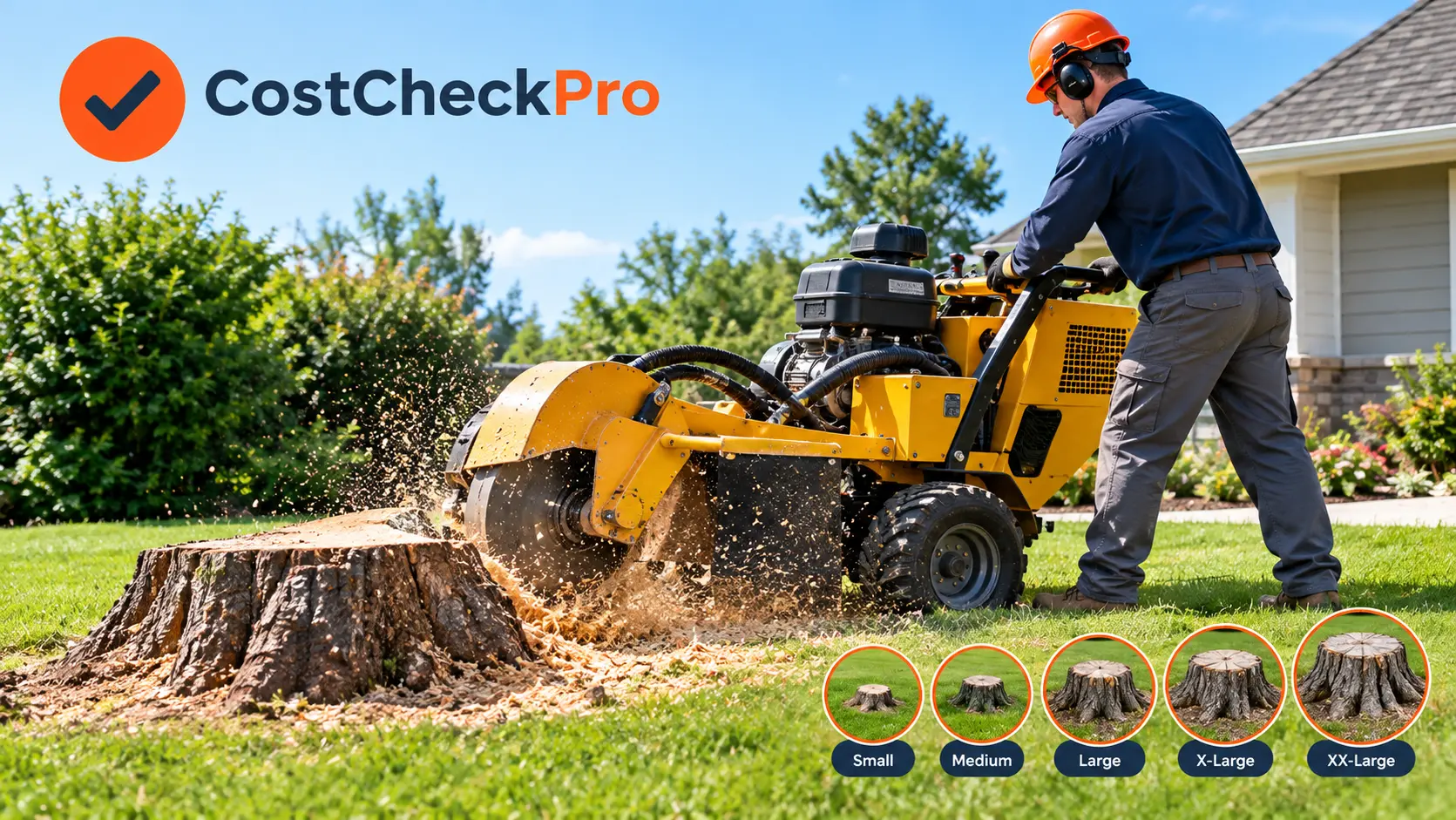
Stump grinding typically costs $3–$6 per inch of stump diameter, with most single-stump jobs landing between $75 and $400 once a minimum service fee is factored in.
Stump grinding is priced almost entirely by one measurement: the diameter of the stump at its widest point. Everything else — root removal, hauling the grindings away — is typically a separate add-on.
How the per-inch pricing works
A roofer measures area in squares; a stump grinding crew measures stumps in inches across. A 20-inch stump at $4 per inch runs about $80 in grinding alone, though most companies apply a minimum charge (often $100–$150) for a single small job to cover the cost of bringing out the equipment.
| Stump diameter | Typical grinding cost |
|---|---|
| Under 12 inches | $75 – $150 (minimum fee often applies) |
| 12 – 24 inches | $100 – $250 |
| 24 – 36 inches | $200 – $350 |
| Over 36 inches | $300 – $500+ |
Grinding vs. full stump and root removal
Grinding chews the stump down below grade and leaves the roots in the ground to decompose naturally — it's faster and cheaper. Full removal pulls the stump and major roots out entirely, which costs more but is sometimes necessary if you're planting a new tree in the exact same spot or dealing with roots lifting a nearby structure.
Multiple stumps? Ask for a bundled rate
If you have several stumps from the same job or property, most companies will quote a day rate or bundled price that's cheaper per stump than booking each one separately — worth asking about if you're clearing more than two or three.
How grinding depth affects price and what comes next
Most residential stump grinding goes 4-6 inches below grade, which is deep enough to cover the stump with soil and plant grass over it without the grinder catching remnants later. Going deeper — sometimes requested before planting a new tree in the same spot — typically adds a per-inch premium beyond the standard depth, since it takes meaningfully longer and puts more wear on the equipment. If you're planning to put anything with a substantial root system in that exact location, it's worth asking for the deeper grind upfront rather than discovering mid-planting that the old stump material is still in the way.
Grinding vs. chemical stump removal vs. burning
| Method | Typical cost | Timeline | Trade-offs |
|---|---|---|---|
| Mechanical grinding | $75 – $400 | Same day | Fastest, most reliable, professional equipment required |
| Chemical stump removers | $20 – $50 (DIY) | 6-12 weeks | Slow, doesn't remove the stump — just accelerates rot for easier manual removal later |
| Burning | Minimal cash cost | Days to weeks | Often restricted or banned locally; safety and permit concerns |
Chemical and burning methods exist mainly for homeowners trying to avoid the cost of professional grinding on a stump in a low-priority area of the yard. For anything near a structure, fence line, or area that will be actively used, mechanical grinding remains the only method that fully solves the problem in a predictable timeframe.
What's left in the yard after grinding
Grinding produces a substantial pile of wood chips and soil mixed together — often more volume than homeowners expect from "just a stump." Most companies leave this pile on-site by default, since it works well as mulch once spread, but will haul it away for an added fee if requested. The hole left where the stump was ground typically needs a few weeks to settle before it's ready for grass seed or sod, as the loosened soil and remaining wood fragments continue to compact and decompose during that window.
Root concerns after grinding
A common misconception is that grinding removes the entire root system — it doesn't. Grinding addresses the visible stump and the first several inches of root flare below grade; the larger lateral roots remain underground and decompose naturally over several years. For most homeowners this is a non-issue, since decomposing roots don't cause structural problems. The exception is roots growing directly under a planned structure or roots already lifting pavement — in those specific cases, root removal, a separate and more invasive service, may be worth discussing with the tree company.
Is stump grinding worth it if you're selling the home?
A ground stump versus a visible one is a small but real factor in how "finished" a yard looks to a buyer walking the property. It's a relatively low-cost fix compared to other pre-sale landscaping work, and removes an obvious sign of a past tree removal that buyers sometimes ask follow-up questions about. For sellers doing broader yard cleanup before listing, stump grinding is usually one of the more cost-effective items on the list.
Equipment size and why it matters for access
Stump grinders come in a range of sizes, and which one a company brings affects both price and what's possible on your property:
- Towable grinders: the most common choice for typical residential jobs, pulled behind a truck and reasonably maneuverable through standard side yards and gates.
- Self-propelled walk-behind grinders: smaller and able to access tighter spaces — narrow gates, backyards with limited clearance — though they take longer on larger stumps since they're less powerful.
- Track-mounted or larger commercial units: used for bigger jobs or multiple stumps, but require wider access and more setup space, which isn't always available on a typical residential lot.
A stump in a tight side yard with no gate access wide enough for a towable unit may require the smaller self-propelled equipment, which can extend job time and, in some cases, increase price — worth mentioning access constraints upfront so the quote reflects the right equipment from the start rather than a surprise on arrival.
Renting a grinder vs. hiring a professional
Stump grinders are available to rent at most equipment rental centers, typically $100-$250 per day depending on the machine size. On paper this looks like meaningful savings over a $150-$300 professional job. In practice, several factors narrow or eliminate that gap: grinders are genuinely dangerous equipment with a real risk of thrown debris and operator injury without training, most rental units are the smaller, slower self-propelled type (meaning a large stump can easily eat an entire rental day), and transporting a grinder typically requires a truck or trailer most homeowners don't have on hand. For a single small stump with some DIY confidence, rental can make sense; for anything larger than roughly 15 inches in diameter, or more than one stump, the time and safety trade-off usually favors hiring out the job.
How soon after tree removal should a stump be ground?
There's no strict deadline, but a few practical reasons favor sooner rather than later: a fresh stump is softer and faster to grind than one that's had years to dry out and harden, it's more likely to still be sending up small shoots that are easier to deal with before they establish, and bundling the grinding into the same visit as the removal — as covered earlier — is typically the cheapest way to handle it. Stumps left for several years are still grindable, just occasionally slower (and in rare cases, marginally more expensive) due to the harder, drier wood.
Stump grinding near underground utilities
Before any grinding work begins, it's worth calling 811 (the national call-before-you-dig line) to have underground utility lines marked, particularly for stumps near the street, driveway or any area where gas, water or electrical lines might run. A grinder cutting several inches below grade can strike shallow-buried lines, and most reputable companies will either require this marking themselves or ask the homeowner to confirm it's been done before starting work near a property's utility easement. This is typically a free service and takes a few business days to schedule, so it's worth requesting early if the stump is anywhere near a utility corridor.
What to expect if the stump is near a foundation or driveway
Stumps growing close to a structure or hardscape add complexity beyond the standard job. Roots may have grown into or under a foundation, driveway or walkway, and grinding alone won't address roots already causing cracking or heaving — that typically requires a structural assessment separate from the tree service itself. For grinding near these features, crews work more cautiously and at a shallower angle to avoid undermining the structure, which can add time to the job. If you're seeing visible cracking or lifting near a stump, it's worth getting that assessed before or alongside the grinding, rather than assuming grinding alone will resolve the underlying issue.
Comparing quotes: what a fair price actually includes
A stump grinding quote that seems unusually low is worth a second look at what's actually included. A complete, fair quote should specify: the per-inch rate or flat fee, whether there's a minimum charge, the grinding depth included at that price, whether grindings/mulch are left on-site or hauled (and at what cost if hauled), and whether multiple stumps on the same visit receive a bundled discount. A quote that's just a single number with none of these specifics is harder to compare against competitors and more likely to come with add-on surprises once the crew is on-site.
Seasonal timing and demand
Unlike tree removal, which can spike sharply around storm season, stump grinding demand is comparatively steady year-round, with a modest increase in spring as homeowners handle leftover stumps before planting season and in fall as part of pre-winter yard cleanup. This means stump grinding pricing is less prone to the seasonal surges seen in emergency tree work, and scheduling flexibility (a company's calendar availability) is usually a bigger factor in timing than seasonal pricing swings.
Regional price differences for stump grinding
| Region | Typical price adjustment | Why |
|---|---|---|
| Northeast | +15% to +25% | Higher labor costs, more hardwood species (oak, maple) that take longer to grind |
| West Coast | +15% to +30% | Higher equipment and labor costs generally |
| South / Gulf Coast | Baseline to -10% | Softer wood species common (pine), lower labor costs |
| Midwest | Baseline | Competitive local market, mix of hard and soft species |
Wood density genuinely affects grinding time and therefore cost — a dense hardwood stump takes meaningfully longer to grind through than a softer species of the same diameter, which is part of why identical-looking stumps in different regions can carry different price tags even accounting for labor cost alone.
Combining stump grinding with other yard work
Homeowners dealing with a stump often have other related yard work on the list at the same time — regrading the area, laying new sod, or installing a garden bed where the stump used to be. While stump grinding companies don't typically handle this follow-up landscaping themselves, timing it close to the grinding (rather than leaving a bare patch for months) tends to produce a better result, since the ground is already disturbed and ready for soil work. Some full-service tree and landscaping companies offer both services together, which can simplify scheduling and sometimes pricing compared to booking two separate contractors for what is, from the homeowner's perspective, one overall yard project.
A quick pre-call checklist
Before calling for quotes, having a few details ready speeds up getting an accurate number:
- Rough stump diameter (a tape measure across the widest point, or even a reasonable estimate)
- How many stumps need grinding, and roughly how far apart they are
- Access notes — gate width, fence lines, distance from the street
- Whether grindings should be hauled away or left as mulch
- Any nearby utilities, structures, or hardscape the stump is close to
Companies that can quote accurately from this information over the phone — without needing an in-person visit for a standard single stump — are common in this trade, which makes shopping multiple quotes relatively low-effort compared to a service like roofing that typically requires an on-site visit for an accurate number.
Licensing and insurance specific to stump grinding
Stump grinding carries its own distinct risk profile — thrown debris, buried utility strikes, and equipment accidents are the most common claims in this specific service, separate from the climbing and rigging risks associated with tree removal itself. A company handling only stump grinding (some operate as a standalone niche business rather than a full tree service) should still carry general liability insurance covering property damage from thrown debris, which is the most common type of incident in this trade. Asking for proof of insurance before work begins is a reasonable, normal request in this industry and a legitimate company will have it readily available, typically as a certificate they can text or email on request.
Putting it all together: a realistic total cost example
Take a mid-size oak stump, 24 inches in diameter, in a Midwest backyard with reasonable access, booked as a standalone visit (not bundled with removal) with grindings left on-site as mulch. At a typical $4-$5 per inch rate with a modest minimum charge already exceeded by the stump's size, this lands in the $96-$120 range for the grinding itself. Add a same-day scheduling convenience and no additional access difficulty, and a realistic total quote for this specific, common scenario comes in around $100-$150 — a useful anchor point when comparing an incoming quote against what's actually typical for a stump of this size and condition.