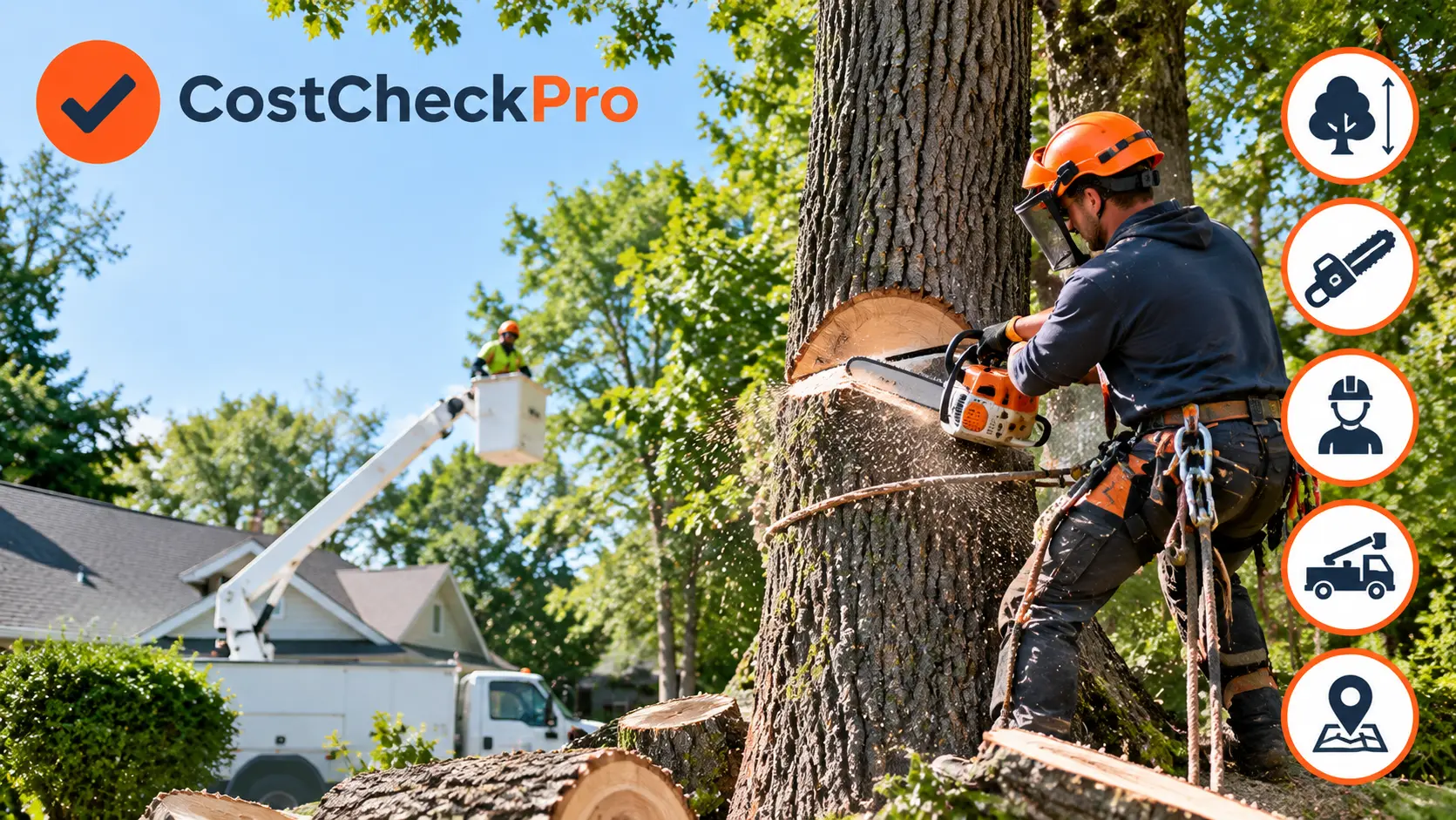
Large trees (60–80 ft.) typically cost $900–$1,700 to remove, and very large trees can run $1,500–$3,000+. Access and condition often matter more than height alone. Try the tree removal estimator for your situation.
It's tempting to assume tree removal pricing is just "bigger tree, bigger bill" — and height does matter — but two trees of nearly identical size can come in thousands of dollars apart depending on where they're standing and what shape they're in. Understanding why helps explain a quote that seems high for a tree that "doesn't look that big."
Height sets the baseline
| Tree height | Typical cost |
|---|---|
| Small (under 30 ft) | $150 – $500 |
| Medium (30–60 ft) | $450 – $950 |
| Large (60–80 ft) | $900 – $1,700 |
| Very large (80+ ft) | $1,500 – $3,000+ |
These ranges assume reasonably open access. From here, three other factors typically explain the rest of the gap between quotes.
Access is often the bigger cost driver than height
A 70-foot tree standing alone in an open backyard is a very different job from a 70-foot tree wedged between a house, a fence and a power line. When a crew can't drop sections straight down, they have to rig and lower each piece by rope — a slower, more labor-intensive process that can add 25–50% to the job.
Power lines change the entire process
Trees growing into or near utility lines often require the power company to de-energize the line or send their own crew to clear the section closest to the wires before the tree company can finish the job safely. That coordination step alone can add both cost and scheduling delay that has nothing to do with the tree's size.
Dead or storm-damaged trees carry their own premium
A dead tree is structurally unpredictable — branches can be brittle and prone to snapping in ways a healthy tree's wouldn't. Emergency removals after a storm carry a further premium on top of that, since crews are working against weather, downed power lines and high local demand all at once.
What's not included in most quotes
- Stump grinding: billed separately, typically $75–$400 based on the stump's diameter.
- Wood hauling: some companies leave cut logs on-site by default unless you request full haul-away.
- Permits: some municipalities require a permit for large tree removal, which is the homeowner's responsibility to obtain in most cases.
How tree removal costs shift by region
Beyond height and access, where you live affects both baseline pricing and how often emergency removals happen in the first place.
| Region | Typical price adjustment | Why |
|---|---|---|
| Gulf Coast / Florida | +10% to +20%, plus storm-season spikes | Hurricane season drives seasonal demand surges |
| Northeast | +15% to +25% | Higher labor costs, dense older trees near older homes |
| Pacific Northwest | +10% to +20% | Larger native tree species (Douglas fir, cedar) require bigger crews |
| Midwest / Plains | Baseline to -10% | Fewer extreme-height trees, lower labor costs |
| South (inland) | Baseline to -15% | Lower labor costs outside hurricane-exposed coastal counties |
What happens on tree removal day
- Site assessment. The crew confirms the fall path is clear, checks for power lines, and decides whether the tree can be felled whole or needs to be taken down in sections.
- Rigging (if needed). For trees near structures, ropes and rigging equipment are set up to control exactly where each cut section lands.
- Cutting. The tree is removed from the top down in sections, or felled in one piece if there's enough open space.
- Limbing and bucking. Branches are removed and the trunk is cut into manageable log sections.
- Stump grinding (if included). The stump is ground down below grade; roots are left in the ground to decompose naturally.
- Cleanup and haul-away. Debris is chipped or hauled, and the yard is raked clear of significant debris.
Permits and HOA rules
Many cities and counties require a permit before removing a tree over a certain trunk diameter, particularly for trees classified as "heritage" or "protected" species — rules that vary significantly by municipality. HOA communities frequently add their own layer of approval on top of city requirements, sometimes requiring a landscaping committee sign-off before any tree over a certain size comes down. Skipping this step isn't just a paperwork risk — some jurisdictions levy fines per unpermitted tree that can exceed the cost of the removal itself. A reputable tree service will usually flag whether a permit applies to your specific tree and municipality before starting work.
Filing an insurance claim for storm-damaged trees
Homeowners insurance typically covers tree removal when a covered peril — wind, storm, lightning — causes the tree to fall and it damages a structure. A few things affect how smoothly that claim goes:
- Document before cleanup. Photos of the fallen tree and any damage, taken before the removal crew arrives, strengthen the claim.
- Get an itemized invoice. Insurers typically want removal and any structural repair billed separately.
- Understand the limit. Many policies cap tree removal coverage at a set dollar amount (often $500-$1,000) even when the fall damaged a structure, with the rest falling under dwelling coverage instead.
A tree that falls but damages nothing — just lying in the yard — is usually not covered, since most policies only pay for removal tied to actual property damage.
Removal methods and why they affect price
Not every tree comes down the same way, and the method a crew has to use is often a bigger cost driver than the tree's height alone.
- Direct felling. The cheapest method — the tree is cut to fall in one open direction. Only possible when there's enough clear space around the tree.
- Climbing and sectional removal. A climber ascends the tree and removes it piece by piece, lowering sections with rope. Used when space is tight or the tree is near a structure. Slower and more labor-intensive, which adds cost.
- Crane-assisted removal. For very large trees in extremely tight spaces, a crane lifts entire sections out. This is the most expensive method, often adding $500-$1,500+ to a job, but it's sometimes the only safe option.
- Bucket truck access. Used when ground conditions or canopy height make climbing inefficient; requires enough clearance for the truck to position near the tree.
How tree species affects removal cost
Beyond height, the species itself changes both the difficulty and the price:
| Tree type | Cost consideration |
|---|---|
| Pine | Tall and relatively light wood, but heavy needle/branch debris adds cleanup time |
| Oak | Dense, heavy hardwood — slower cutting and more weight to manage, which raises labor cost |
| Palm | Different equipment and technique than hardwoods; pricing varies significantly by palm height and trunk diameter |
| Maple | Wide canopy often means more limbing work before the trunk can come down |
| Dead or diseased trees (any species) | Brittle wood is less predictable, often requiring extra caution and sometimes a safety premium |
Preparing your property before the crew arrives
- Clear the area around the tree. Move vehicles, patio furniture and anything breakable out of the fall zone and surrounding work area.
- Note any underground utilities or irrigation lines near the tree's base, especially if stump grinding is included — grinding equipment can damage shallow lines.
- Confirm access for equipment. If a bucket truck or crane is needed, make sure there's a clear path from the street — this is worth confirming with the company in advance, not discovering on the day of service.
- Plan for noise and several hours of disruption. Larger or more complex removals can take most of a day, especially with stump grinding included.
Why DIY tree removal usually costs more than it saves
Renting a chainsaw for a day is inexpensive, which makes DIY removal tempting for a seemingly manageable tree. The real costs that rarely get factored in:
- Safety equipment. Proper chaps, helmet, eye and ear protection add up, and skipping them is how most chainsaw injuries happen.
- Liability. A DIY removal that damages a fence, a neighbor's property, or a power line can cost far more than the professional quote would have.
- Disposal. Renting a chipper or hauling debris to a transfer station yourself often costs more in time and rental fees than expected.
- The tree itself is unpredictable. Rot, lean, and internal decay aren't always visible from the ground — professional arborists are trained to read these signs before the first cut.
Small, non-hazardous trees in open yards with no structures nearby are the one scenario where DIY removal is genuinely reasonable for an experienced homeowner with the right equipment. Anything near a structure, power line, or with any lean toward a target is worth professional judgment.
Tree removal vs. tree trimming: a full cost comparison
| Tree trimming | Tree removal | |
|---|---|---|
| Typical cost | $150 – $875 depending on size | $150 – $3,000+ depending on height/access |
| What it solves | Overgrown branches, storm-damage prevention, aesthetics | Dead, hazardous, or unwanted trees |
| Frequency | Recurring, every 1-3 years | One-time |
| Tree survives | Yes | No |
Trimming is almost always cheaper per visit, but it's a recurring cost over the life of the tree, while removal is a single larger expense that ends the ongoing maintenance need entirely. For a tree that's structurally healthy but just overgrown, trimming is nearly always the better financial choice; for one that's dead, diseased, or a genuine safety hazard, trimming simply delays an eventual removal while the hazard remains.
Warning signs a tree needs to come down
- Large dead branches throughout the canopy, not just a few isolated ones — a sign of broader decline rather than a single damaged limb.
- Fungal growth at the base or visible cavities in the trunk, which often indicate internal rot compromising structural stability.
- A significant lean that's new or worsening, especially after a storm — a sign the root system may be failing.
- Cracks running down the trunk or splitting at major branch unions, both signs the tree could fail under wind load.
- Roots visibly lifting near the base on one side only, suggesting the tree is being pushed over rather than growing normally.
Any one of these alone isn't necessarily an emergency, but it's worth a professional assessment — especially for trees near a home, driveway or power line.
Choosing a certified arborist vs. a general tree service
Not every company that removes trees employs a certified arborist, and for most straightforward removals, that's not a problem — a licensed and insured tree service can safely do the physical work. Where an ISA-certified arborist adds real value is in judgment calls: diagnosing whether a tree is actually failing or just naturally mature, assessing whether trimming can extend its life safely, or navigating a dispute with a neighbor or HOA about tree health. For routine removal of an obviously dead or storm-damaged tree, licensing and insurance matter more than certification; for anything requiring a diagnosis, the certification is worth paying for.
Is stump grinding worth adding to the job?
Bundling stump grinding into the same visit as removal is almost always cheaper than scheduling it separately later, since the crew and equipment are already on-site. A standalone stump grinding visit typically carries its own minimum service fee ($100-$150) on top of the per-inch cost, which bundled pricing usually avoids. The main reason to skip it is cost in the moment — but for most homeowners planning to replant, landscape over the area, or simply avoid a visible stump, bundling at time of removal is the more economical choice.
What you're actually paying for
A tree removal quote isn't just "cutting down a tree" — it's a bundle of distinct cost drivers that together make up the final number:
- Labor (typically 40-50% of the quote): an experienced crew of 2-4, often working at height with specialized rigging skills.
- Equipment (15-25%): chainsaws, chippers, cranes or bucket trucks for larger or harder-to-access trees, and their transport and operating costs.
- Disposal and hauling (15-20%): chipping, log transport, and dump or recycling fees for the resulting debris.
- Insurance and overhead (10-15%): liability coverage is substantial in this trade given the risk involved, and legitimate companies price it into every job.
This breakdown is also why the cheapest quote on a tree job deserves extra scrutiny — cutting corners on insurance or using undersized equipment for a given tree is one of the more common ways a bargain price turns into a safety incident.
Multiple tree discounts
If several trees need to come down on the same property visit, most companies offer a meaningful discount over booking each one separately — often 10-20% off the combined individual prices — since mobilization (bringing the crew and equipment out) is one of the larger fixed costs in a single-tree job, and that cost is shared across multiple trees in one visit. Worth mentioning upfront if you know several trees need attention, even if you're only budgeting for one right now.
Cost by common tree species
Height and access explain most of a removal quote, but species matters too — wood density, root structure and typical size all shift the price within a given height bracket.
| Species | Typical removal cost | Why |
|---|---|---|
| Pine | $200 – $1,500 | Tall and straightforward to fell, but can be very large |
| Oak | $400 – $2,000 | Dense hardwood, extensive root system, often large canopy |
| Maple | $300 – $1,800 | Moderate density, common near homes so access is often tighter |
| Palm | $150 – $900 | Lighter wood, but often requires specialized climbing technique |
These ranges still move with the same height, access and condition factors covered earlier — species sets a baseline, but a 70-foot oak next to a power line will still cost more than a 70-foot oak in an open field.
Does removing a tree affect property value?
It depends heavily on which tree and why. Removing a genuinely hazardous, dead or disease-damaged tree typically protects value — buyers and appraisers see standing risk, not standing shade. Removing a healthy, mature, well-placed tree can occasionally reduce curb appeal and perceived value, particularly in markets where mature landscaping is a selling point. The safest framing: if a tree is a documented hazard, removal is close to value-neutral to positive; if it's healthy and simply inconvenient, it's worth weighing the landscaping loss against the reason for removal before committing.