You file a claim. You wait for the adjuster. Then you find out your roof is only "partially" covered, or not covered at all. This catches a lot of homeowners off guard, and it usually comes down to one question insurers ask before anything else: did something sudden and accidental damage this roof, or did it simply wear out?
Quick answer
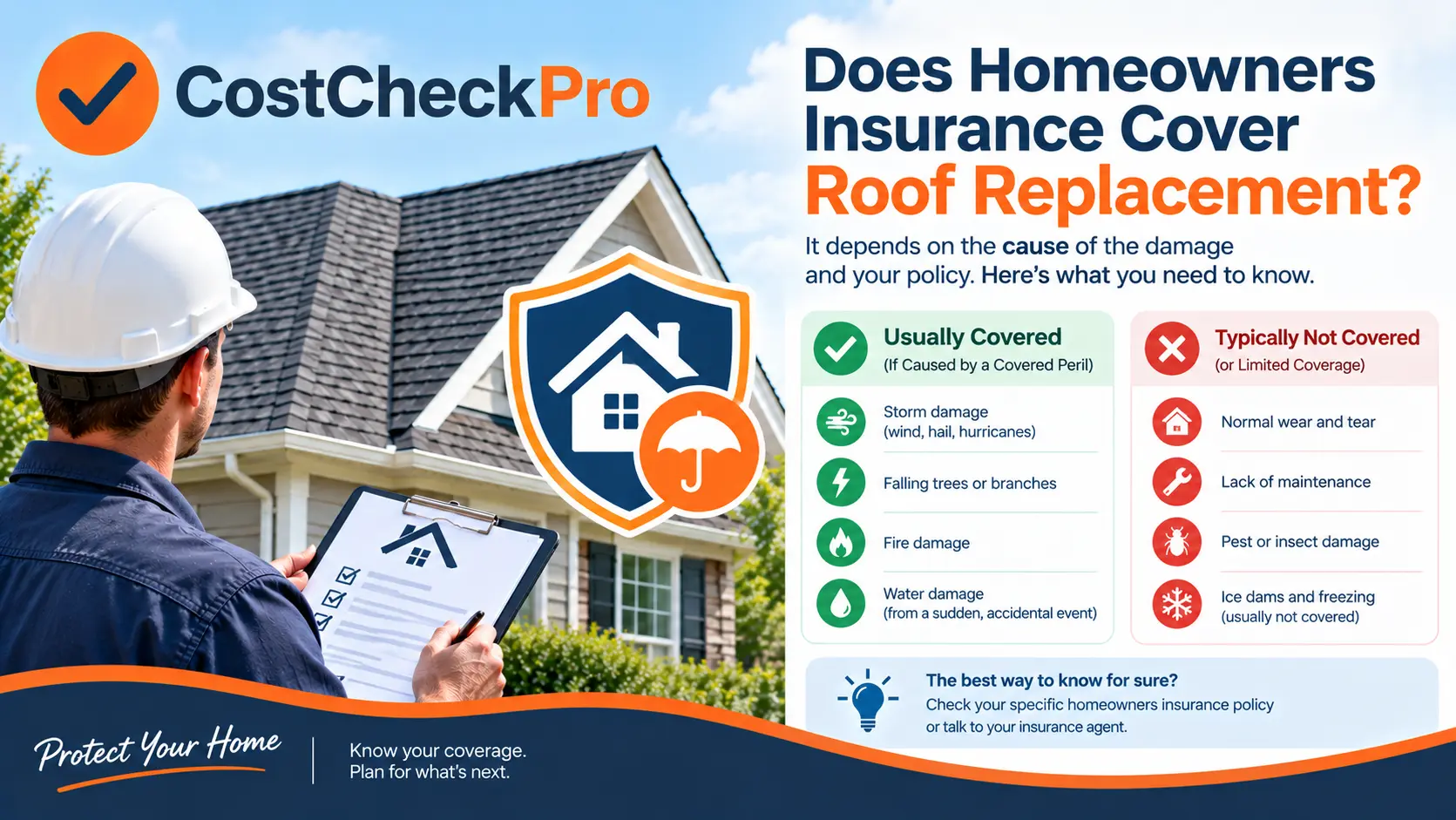
Homeowners insurance typically covers roof replacement when the damage comes from a covered peril like wind, hail, fire, or a fallen tree. It does not cover a roof that's failing from age, wear, or lack of maintenance. Most standard policies also shift how much they pay once a roof crosses a certain age, often 15 to 20 years, switching from full replacement cost to actual cash value, which pays out less.
What counts as a covered peril
| Cause of damage | Usually covered? |
|---|---|
| Wind (storms, tornadoes) | Yes |
| Hail | Yes, though often with a separate deductible |
| Fire | Yes |
| Fallen tree or branch | Yes |
| Lightning strike | Yes |
| Normal wear and aging | No |
| Poor maintenance or neglect | No |
| Faulty original installation | No, usually a contractor liability issue instead |
| Flood (unless separate flood policy) | No |
The pattern here is simple once you see it. Insurance covers sudden, accidental events. It was never designed to cover something that was always going to happen eventually, the same way a car insurance policy won't pay to replace worn brake pads.
Why age matters so much to insurers
A 25-year-old shingle roof and a brand new one can suffer identical hail damage, but insurers treat them very differently. The older roof was already near the end of its useful life. Some adjusters will argue the hail just accelerated an outcome that was coming anyway, which affects how much they're willing to pay. Many insurers also require a roof inspection before renewing a policy once the roof passes a certain age, and a few will decline to renew entirely if the roof looks worn, regardless of whether a storm has happened yet.
Replacement cost value vs actual cash value
This is the distinction that determines how much money actually lands in your account after a claim, and most homeowners don't learn the difference until they need it.
Replacement cost value (RCV)
Pays what it actually costs to replace the roof today, with no deduction for age or wear. This is the better coverage type, and it's what most homeowners assume they have until a claim proves otherwise.
Actual cash value (ACV)
Pays replacement cost minus depreciation. A 15-year-old roof on a 25-year expected lifespan might only get paid out at 40% of its replacement cost, because the insurer calculates the roof already used up 60% of its useful life. The gap between what ACV pays and what a new roof costs can be thousands of dollars that comes straight out of your pocket.
Many policies start as RCV and automatically convert to ACV once a roof hits a certain age, often 15 to 20 years. Check your actual policy documents rather than assuming, since this detail rarely gets mentioned until claim time.
How the claims process actually works
- Document the damage immediately. Photos and video, taken as soon as it's safe, before any cleanup or temporary repairs.
- Call your insurer to open a claim. Most have a window, often one year, for filing after the damage occurred, so don't wait.
- An adjuster inspects the roof. They'll assess cause, extent, and whether it matches a covered peril.
- You get a scope of work and payout estimate. This outlines what the insurer will pay for and how.
- You hire a contractor and complete repairs. If your policy is RCV, you often get a second payment once the work is done and proof is submitted.
What roofing contractors can and can't do with your claim
A reputable roofing contractor can meet the adjuster on-site, point out damage that might otherwise get missed, and help translate the insurance scope of work into an actual repair plan. What they shouldn't do is promise to "handle everything" in a way that involves waiving your deductible or inflating the damage report, both of which are insurance fraud and can leave you liable even if the contractor suggested it. A contractor who seems more interested in the insurance payout than the actual roof condition is a red flag worth taking seriously.
Common reasons roof claims get denied
- The damage is attributed to age or wear rather than a specific storm event.
- Pre-existing damage that predates the claimed event, sometimes spotted through satellite imagery insurers now use.
- Lack of maintenance that the insurer argues contributed to or worsened the damage.
- Missed filing window, often one year from the date of loss depending on your state and policy.
- Cosmetic-only damage that doesn't affect the roof's function, which some policies exclude even if it came from a covered storm.
The wind and hail deductible most homeowners don't know they have
In many storm-prone states, especially along the Gulf Coast and in parts of the Midwest, policies carry a separate, higher deductible specifically for wind and hail claims, often calculated as a percentage of your home's insured value rather than a flat dollar amount. A 2% wind and hail deductible on a home insured for $350,000 works out to $7,000 before coverage kicks in, a very different number than the flat $1,000 deductible many homeowners assume applies to every claim. Checking this number before a storm hits, not after, avoids an unpleasant surprise mid-claim.
Partial damage: do you get a full new roof or just a patch?
This depends heavily on your state and your specific insurer. Some states have matching laws that require an insurer to replace an entire roof slope, or sometimes the whole roof, if the available shingles no longer match the damaged section closely enough. Other states and policies allow the insurer to pay only for repairing the damaged section, leaving you with a roof that's a patchwork of old and new material. If matching matters to you, it's worth confirming how your state and policy handle this before you're in the middle of a claim and discovering the answer the hard way.
How roof material affects both premiums and claims
Impact-resistant shingles and metal roofing often qualify for a premium discount in hail-prone states, since insurers have data showing these materials hold up better and generate fewer claims. On the claims side, these same materials can sometimes make a claim harder to win, specifically because they're more resistant to damage. An adjuster might argue cosmetic hail marks on impact-resistant shingles don't affect function, where the same marks on standard shingles would more clearly justify a payout. It's a strange tradeoff: better material, lower premium, occasionally a tougher claims conversation.
What to do if your claim gets denied
Request the denial in writing with the specific reason stated, not just a verbal explanation over the phone. Get an independent roofing contractor's assessment separate from the insurer's adjuster, since a second opinion sometimes catches damage or context the first inspection missed. Most states allow you to request a second inspection or file a formal appeal, and your state's Department of Insurance can get involved if you believe the denial was handled in bad faith. A public adjuster, who works for you rather than the insurance company, is another option worth considering for a large claim that's been denied or significantly underpaid, though they typically take a percentage of the eventual payout as their fee.
Preventing a denial before it happens
Keep records of roof maintenance and any repairs over the years, since this is your evidence against a "lack of maintenance" denial. Get a roof inspection every few years even without a specific storm trigger, and keep that documentation on file. Address small issues, a loose shingle, a minor flashing leak, promptly rather than letting them sit, since an insurer that finds evidence of a long-neglected small problem can use it to deny a much larger claim later. None of this guarantees a smooth claim, but it removes some of the easiest grounds for denial.
Should you file a claim for every bit of roof damage?
Not necessarily. Filing a claim, even one that gets paid, can affect your premium at renewal, and multiple claims within a short window can sometimes lead to a non-renewal. For minor damage well under your deductible, paying out of pocket is often the smarter long-term move. For anything approaching or exceeding your deductible, especially after a significant storm that likely affected your whole neighborhood, filing usually makes sense since the insurer is already fielding similar claims in your area.
Getting a repair estimate before you file
Before you call your insurer, it helps to have a rough sense of what repair or replacement actually costs, so you know whether a claim is worth pursuing and can sanity-check whatever the adjuster comes back with. Our roof replacement cost calculator gives you a quick estimate based on your roof size and material, and our guide on how long a roof actually lasts is useful context if an insurer is trying to argue your roof's age, not the storm, is the real cause of the damage.
What an adjuster actually looks for during inspection
An insurance adjuster walks the roof looking for specific, telltale signs tied to the claimed cause of damage. For hail, that means circular bruising on shingles, often checked by running a hand across the surface to feel for soft spots rather than relying on sight alone, since hail damage isn't always visually obvious from a distance. For wind, they look for shingles that are lifted, creased, or missing entirely, along with the pattern of where the damage sits relative to the direction the storm came from. They'll also check flashing around chimneys and vents, since these areas fail differently than open shingle fields and sometimes tell a more accurate story about what actually happened. An adjuster who finds damage that doesn't match the claimed storm date or direction is one of the fastest routes to a denial, which is part of why documenting damage immediately after an event matters so much.
Satellite imagery and how insurers use it against claims
A growing number of insurers now use satellite and aerial imagery services to track a roof's condition over time, sometimes going back several years. This means an insurer can potentially pull up an image from before your claimed storm date and compare it to current damage, looking for evidence the problem already existed. This technology cuts both ways. It can support your claim by showing the roof was clearly undamaged before a specific date, or undermine it by showing wear that predates the storm you're claiming against. Keeping your own dated photos over the years, even just casual ones taken for other reasons, can serve as useful evidence if an insurer's imagery analysis gets disputed.
How a roof's slope and complexity affect insurance scrutiny
A simple, low-complexity roof is generally easier for an adjuster to assess quickly and consistently. A roof with many valleys, dormers, and varying pitches gives more surface area where damage assessment can become subjective, and more room for disagreement between your contractor's assessment and the insurer's. This doesn't mean complex roofs get worse coverage, but claims on them sometimes take longer to resolve and involve more back-and-forth negotiation over exactly which sections need replacement versus repair.
State-specific rules worth knowing
Insurance regulation varies significantly by state, and a few patterns are worth understanding if you want to know your specific situation rather than a national generality. Some states, often ones with frequent severe hail, have passed laws restricting how insurers can handle roof claims, including rules around matching and minimum payout standards. Other states allow insurers much more flexibility in applying depreciation and choosing repair versus full replacement. Florida and other hurricane-prone states have their own specific wind mitigation credit systems, where certain roofing upgrades can lower your premium regardless of claims history. Checking your own state's Department of Insurance website for homeowner-specific guidance is worth the twenty minutes it takes, since generic national advice can miss state-specific protections or restrictions that directly affect your claim.
Roof replacement during a home sale: who pays?
If storm damage is discovered during a pre-sale inspection, the question of who files the claim and who receives the payout gets complicated fast. Generally, the person who owned the home at the time the damage occurred is the one with a valid claim, even if the sale closes before repairs happen. This sometimes gets negotiated into the sale contract directly, with the seller either completing repairs before closing or crediting the buyer for the expected cost. A buyer should never assume a visibly aging or damaged roof will simply become their problem to claim on their own new policy, since a pre-existing condition at the time a new policy starts is typically excluded from coverage under that new policy.
What "code upgrade" coverage means and why it matters
Building codes change over time, and a roof replacement triggered by a covered claim sometimes needs to meet current code requirements that didn't exist when the original roof went on, things like updated ventilation standards, ice and water shield in colder climates, or wind-rating requirements in coastal zones. Standard policies often don't automatically cover this gap between what your old roof had and what code now requires. A separate endorsement, sometimes called ordinance or law coverage, specifically covers this difference, and it's worth asking your insurer whether your policy includes it, since without it you could be responsible for the cost of code-required upgrades even on an otherwise fully covered claim.
FAQs
Does homeowners insurance cover a roof leak?
Only if the leak comes from a sudden, covered event like a storm. A leak from gradual wear, old flashing, or a long-neglected small problem usually isn't covered, since insurers treat gradual deterioration differently from sudden damage.
Will my premium go up after a roof claim?
Often, yes, though the increase depends on your insurer, your claims history, and whether the damage was widespread storm damage affecting many homes versus an isolated claim on your property alone.
Does insurance cover a roof replacement due to normal aging?
No. Age-related wear is considered a maintenance issue, not an insurable event, which is why insurers draw such a hard line between storm damage and a roof that simply reached the end of its lifespan.
What's the difference between a wind deductible and a regular deductible?
A wind or hail deductible is often a separate, higher amount, sometimes a percentage of your home's value rather than a flat number, and it applies specifically to wind and hail claims instead of your standard flat deductible.
Can an insurance company refuse to renew my policy because of an old roof?
Yes, this happens in many states. Insurers increasingly require roof inspections for homes with older roofs and can decline renewal or require replacement before continuing coverage.
Do I need a public adjuster for a roof claim?
Not for most straightforward claims. For a large or disputed claim, especially one that's been denied or significantly underpaid, a public adjuster can be worth the fee since they negotiate on your behalf rather than the insurer's.
How long do I have to file a roof damage claim after a storm?
This varies by state and policy, but one year from the date of loss is a common window. Some policies and states allow longer, some shorter, so check your specific policy rather than assuming a standard timeline applies.
Does filing a claim mean I have to use the insurer's recommended contractor?
No. You have the right to choose your own licensed contractor for the repair work, regardless of which contractor the insurer or adjuster might suggest.
What happens if I disagree with the adjuster's damage assessment?
You can request a re-inspection, bring in your own contractor's written assessment as supporting evidence, or invoke your policy's appraisal clause if one exists, which brings in a neutral third party to settle the disagreement between your estimate and the insurer's.
Does a new roof lower my homeowners insurance premium?
Often yes, especially if you upgrade to impact-resistant shingles or metal roofing in a hail or storm-prone area. Many insurers offer a specific discount for these materials, so it's worth asking your insurer directly after a replacement.
A realistic example of how a claim plays out
A hailstorm hits a neighborhood built in the same year, with roofs averaging 12 years old. A homeowner notices dents in their gutters and calls their insurer within a week. The adjuster inspects, confirms hail bruising consistent with the storm date, and approves a full replacement under the RCV portion of the policy, since the roof hadn't yet crossed the age threshold that would trigger ACV depreciation. The homeowner pays their standard deductible, not the higher wind and hail deductible, since their specific policy didn't carry a separate one. A contractor completes the replacement within three weeks, submits proof of completion, and the insurer releases the remaining payment. Total out-of-pocket cost: just the deductible. This is roughly what a smooth, well-documented claim looks like when the damage clearly matches a covered event and the paperwork is handled promptly on both sides.
Contrast that with a neighbor two doors down whose roof was already 22 years old at the time of the same storm. Their insurer's inspection reached a similar conclusion on cause, but their policy had already converted to ACV coverage at that age. The payout reflected depreciated value rather than full replacement cost, leaving a meaningful gap the homeowner had to cover directly. Same storm, same neighborhood, same insurer even, but a very different outcome driven entirely by roof age and policy terms rather than anything either homeowner did differently.